Diagram questions
Parking and Reversing Diagrams
Where the picture says you cannot leave the car
Look for a crossing, a corner, a bend, a brow, a traffic light, and a sign with a red circle over a parking symbol. Those are the usual "which car is badly parked?" answers. A car facing against the flow, parked on the right in a two-way street, is also the one they want, because we keep left and park with the traffic.
Reversing
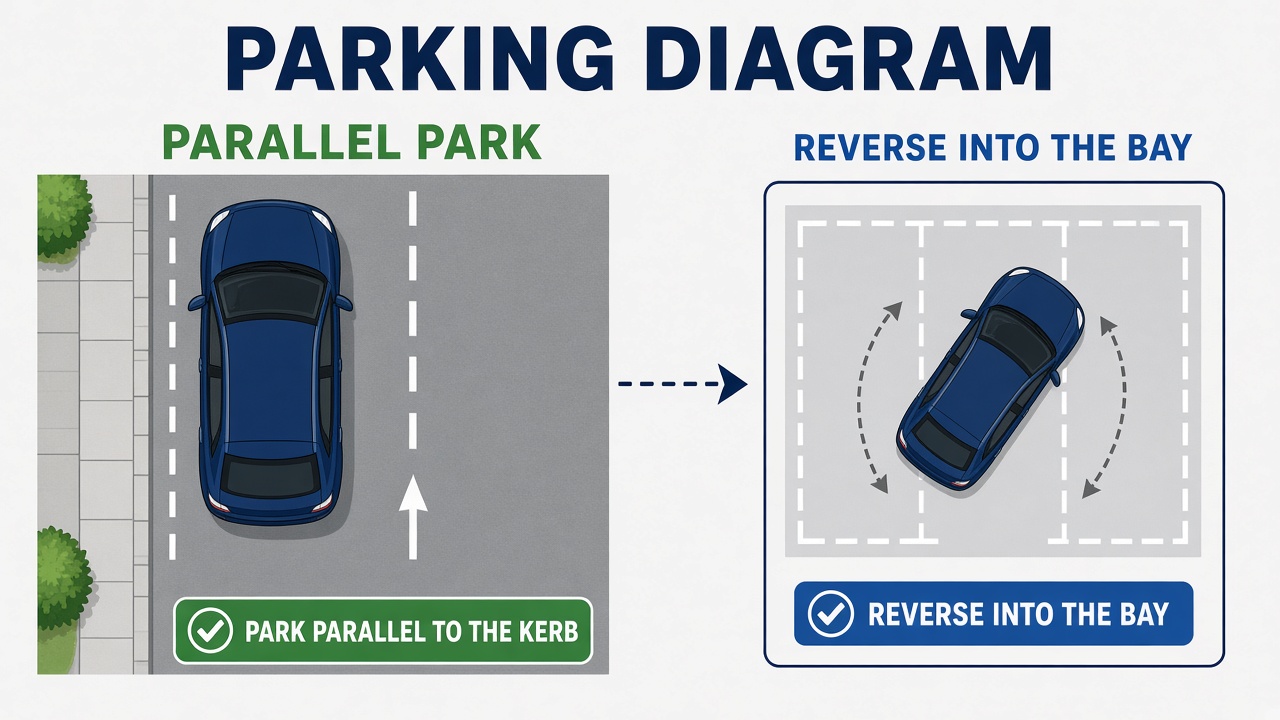
The diagram of a bay asks whether you reverse in or drive in and reverse out. Reversing in, while you can still see the bay and the traffic, is the safer manoeuvre taught for the test: you leave later by driving forward into the lane. While the car is moving backward you give way to other traffic and to pedestrians, and you look back rather than trusting only the mirrors.
On-road parking is also a practical-test skill. Theory is in PassDrive. In Harare the car and the instructor can be booked with Appheal.
Free practice question
These are PassDrive practice examples, written so you learn the rule. The VID screen randomises its questions, so the wording on the day will be different.
Practice
Which parked car is unlawful in a typical test diagram?
- Parallel to the kerb, on the left, clear of a driveway
- On the zig-zag markings before a pedestrian crossing
- In a marked bay
- Well back from a corner, on the left
Show the answer
B. On the zig-zag markings before a pedestrian crossing. Those markings keep the approach clear so drivers and pedestrians can see each other. Parking there is prohibited.
Questions people ask
Does the provisional test include a real reverse park?
The computer test uses diagrams and rules. The physical reverse and parallel park belong to the practical test later.