Road signs
Road Markings and Their Meanings
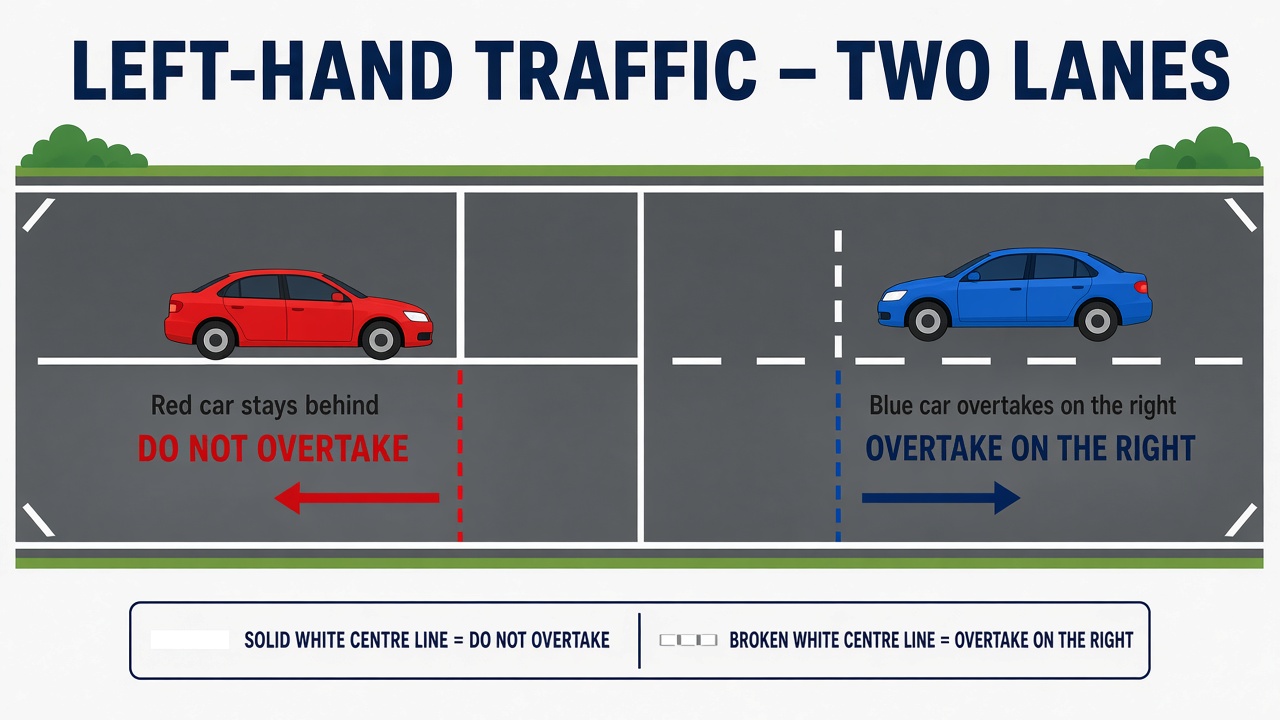
Centre lines
Zimbabwe keeps left. The centre line tells you when you may move onto the right side to overtake or to turn. A broken line means you may cross it if the road ahead is clear and the manoeuvre is safe. A solid line means you stay on your side. Do not overtake. A double solid line binds both directions.
A line does not give you priority. It only says whether crossing it is allowed. You still give way, indicate, and abandon the overtake if the gap closes.
Edges, boxes and crossings
Edge lines show the side of the carriageway. Zig-zag or crossing markings on the approach to a pedestrian crossing are a no-parking, no-overtaking zone. A stop line belongs with a stop sign or a red light: you stop behind it, not on it.
Diagram questions love a solid line next to a slow truck. The correct car is the one that waits. See overtaking rules.
Free practice question
These are PassDrive practice examples, written so you learn the rule. The VID screen randomises its questions, so the wording on the day will be different.
Practice
The line in the middle of the road changes from broken to solid as you catch a slow car. What do you do?
- Finish the overtake quickly
- Stay behind until the line is broken again and the road is clear
- Overtake on the left
- Flash the slow car
Show the answer
B. Stay behind until the line is broken again and the road is clear. A solid centre line is a prohibition on crossing to overtake, even if the car ahead is slow.
Questions people ask
May I cross a solid line to turn into a driveway?
The usual test answer about overtaking is no. Turning across a solid line into a property is a different manoeuvre and is often unlawful too if the line is there because of hidden danger. If the question says "overtake", the answer is no.